
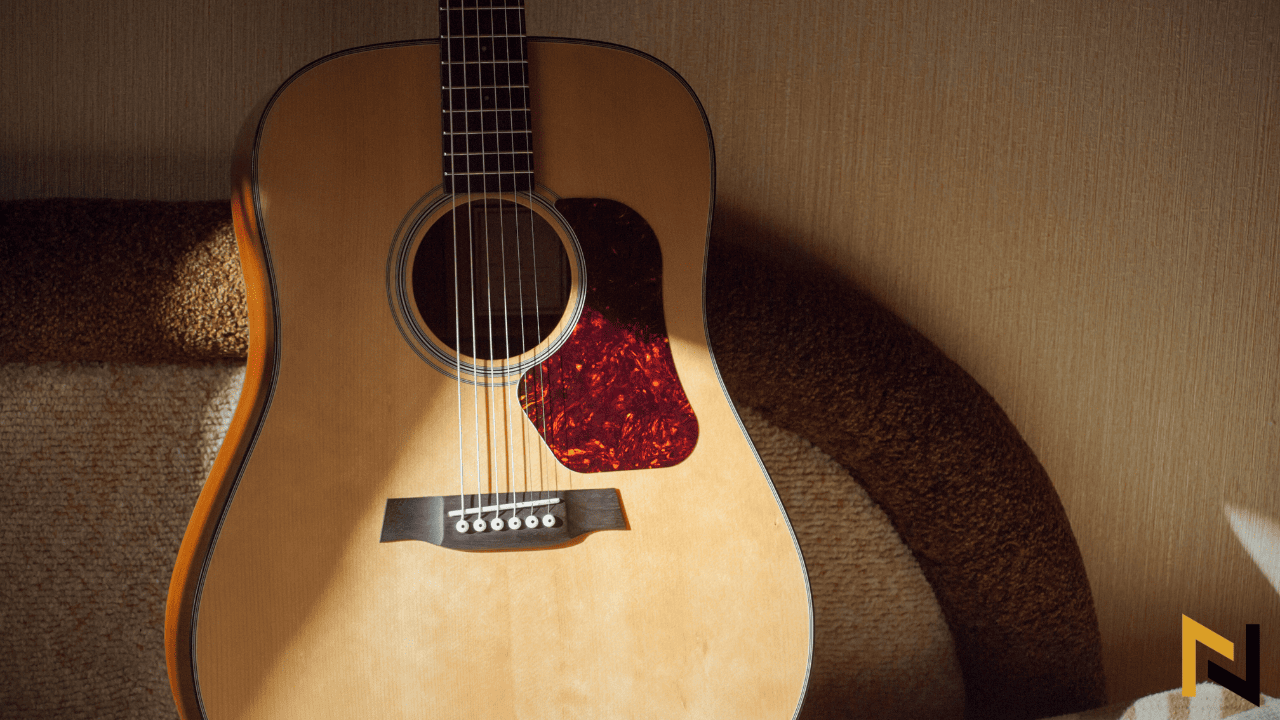

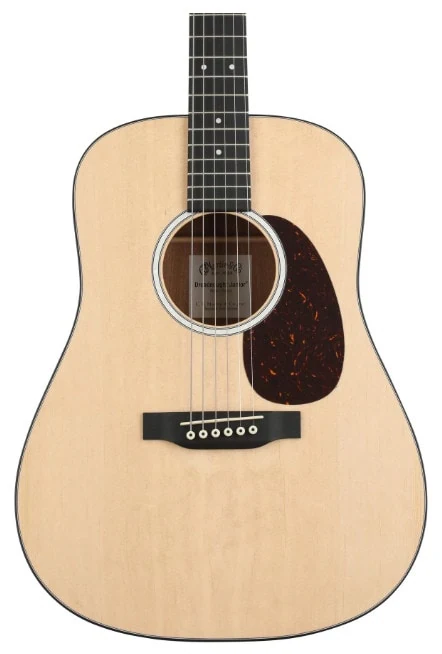
Best Overall– Martin DJR-10
Summary
Pros:
-Martin tone at a fraction of Martin’s regular prices
-Solid-wood guitar (top, backs and sides, and neck)
-Top-notch scalloped bracing for enhanced low-end
-Lightweight and travel-friendly
-Dedicated gig bag included
Cons:
-Fishman Sonicore lacks low end.
-Richlite fingerboard and bridge might seem a little too plastic for some purists.
Who is this guitar for?
This guitar is perfect for the amateur player trying to take a leap in build quality and sound, beginners, and children in need of a learner-size guitar. Also, it makes a terrific road-ready guitar to leave your precious full-size Martin safe at home without sacrificing tone.
The Next Best:
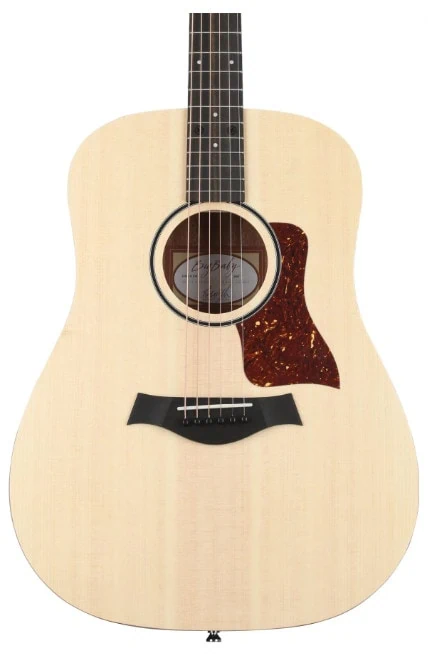
Runner-Up – Taylor Big Baby Taylor
Check Today’s Price on
Summary
Pros:
- 25 ½” scale on a 15/16 body
- Ebony fingerboard
- Solid Sitka spruce top
- Durable, rugged gig bag
- Offers the Taylor sound
- Great playability, friendly neck
- Real Taylor at an affordable price
Cons:
- Laminated back and sides
- No electronics
- Maple neck
Who is this guitar for?
The wood combination of neck, body, fretboard, and top makes this a killer lead instrument. Yes, that mix between the snappy highs of the maple and the ebony together with the high end of the spruce, and anchored by walnut’s midrange can cut any mix.
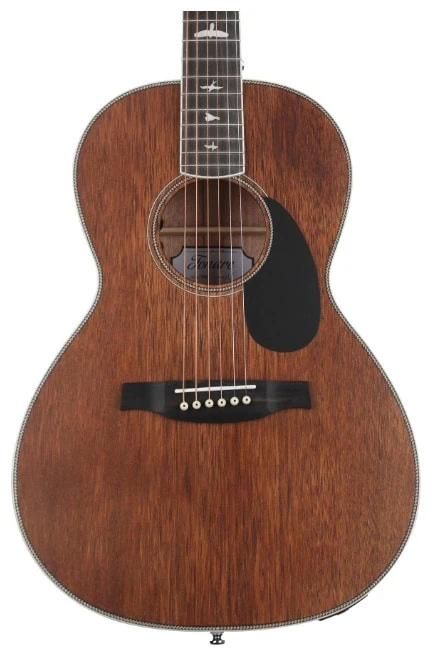
Best for Fingerpicking – PRS SE P20E
Check Today’s Price on
Summary
Pros:
- Solid mahogany top for added low end
- Hybrid bracing to enhance the tones from the solid top
- Included gig bag
- Mahogany neck with traditional bird inlays and binding
- Fishman Sonitone installed
- Wide Fat neck profile for enhanced comfort and playability
Cons:
- Laminated back and sides
- 3-piece neck
- Fishman Sonitone is not the best for picking up the low end
Who is this guitar for?
This is the perfect guitar for those who love fingerpicking and need the snappy high end of the guitar to cut through the mix. Also for those who like smaller-body and want the quintessential PRS look and tone at a fraction of the price.
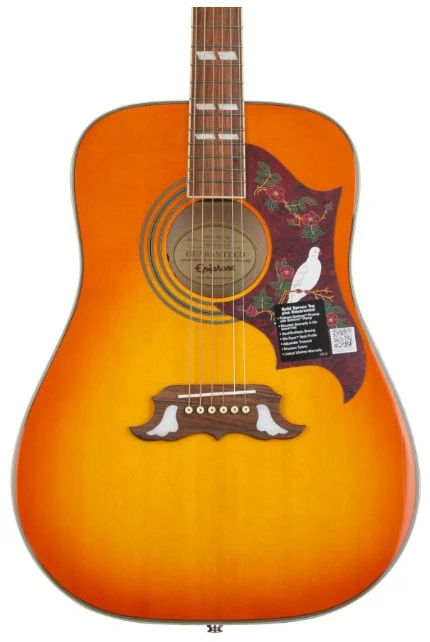
Best for Strumming – Epiphone Dove Studio
Check Today’s Price on
Summary
Pros:
- Historic Dove pickguard and perfect finish
- Packs countless classic tones
- The hard maple neck makes it more resistant and road-ready
- Fishman Sonitone preamp system as a factory feature
- Violin burst finish
- Glossy finish
Cons:
- Laminated back and sides
- No gig bag included
Who is this guitar for?
This is for the owner of an original who wants to preserve that guitar and hit the road with a budget-level guitar. Also for the amateur musician and the bonfire lover who needs a great guitar that won’t break the bank but deliver classic acoustic tones for timeless masterpieces. Works well for a singer songwriter too.
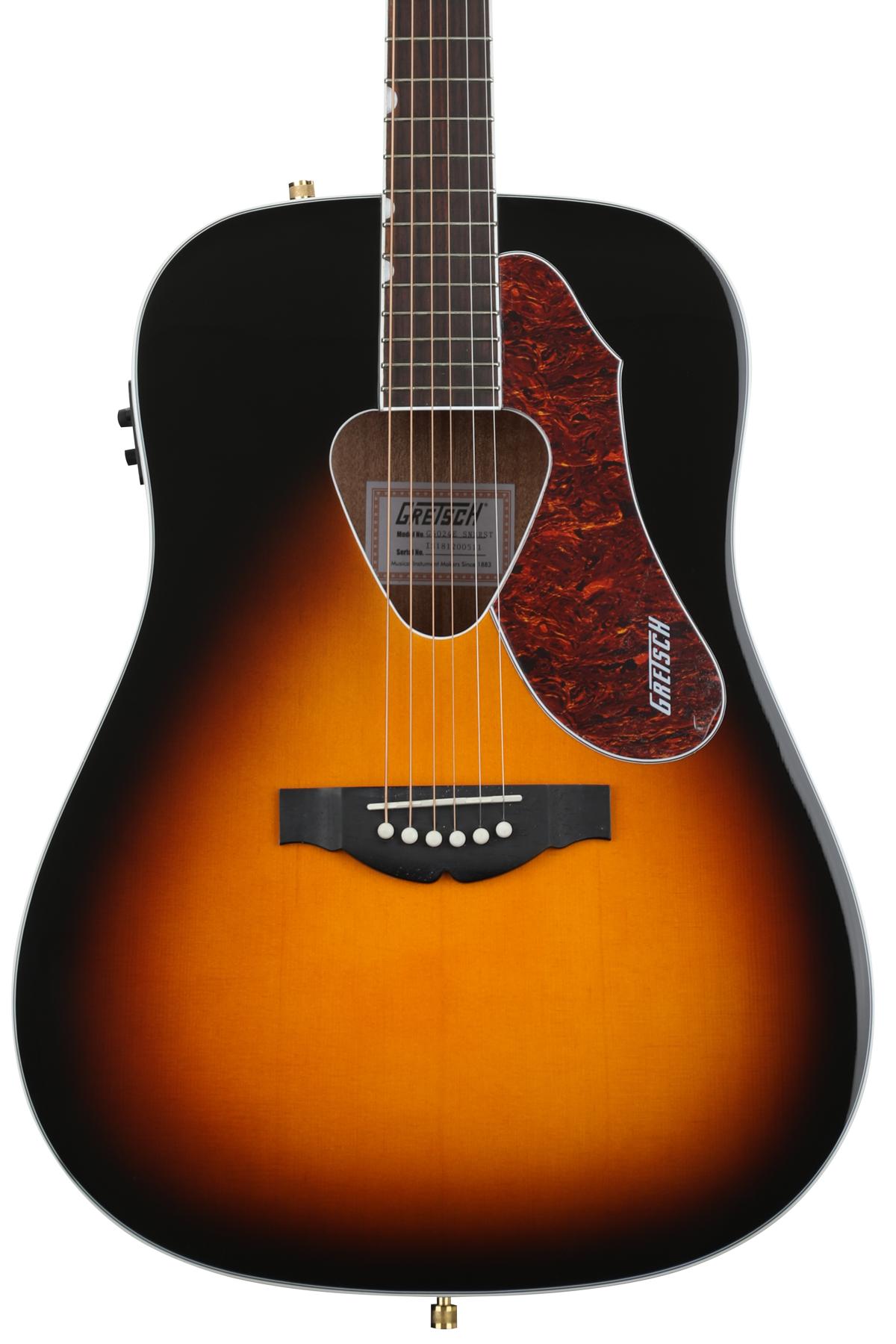
Best For Blues – Gretsch G5024E Rancher
Check Today’s Price on
Summary
Pros
- The unusual triangle-shaped soundhole is unique and eye-catching
- A powerful, rich voice from an arch back design
- Arched-back design boosts volume
- Great acoustic tone with a decent electronic system
- Vintage-style frets let your fingers feel the fretboard
- You really feel the instrument when playing
- Comfortable and slim neck
- Versatile, delivers from delta blues to blues rock
Cons
- Non-cutaway acoustic-electric limits high fret access
- Synthetic bone nut and saddle
Who is this guitar for?
If you are in search of a solid top guitar that handles blues exceptionally well and is comfortable to play the Gretsch G5024E Rancher is easily one of the best options for under $500.
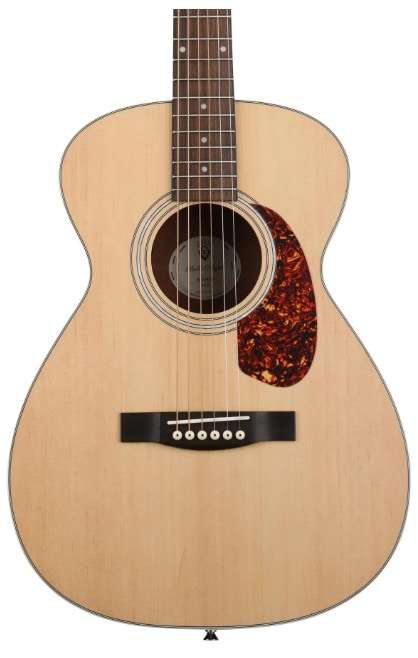
Best for Beginners – Guild M-240E
Check Today’s Price on
Summary
Pros:
- Solid Sitka spruce top
- Padded gig bag
- Factory-included Fishman Sonitone electronics
- Comfortable C-Shaped neck
- Prototypical wood combinations and tones
- Scalloped X internal bracing for added tone and sustain
Cons:
- Laminated back and sides
- Pau Ferro fingerboard and bridge instead of rosewood or ebony
Who is this guitar for?
This is the perfect guitar to play countless gigs on; so, if you’re an artist looking for a workhorse, here’s your guitar. Also, beginners who want a mid-range instrument to focus their fight against their hands and brains instead of a faulty guitar will find this Guild a great choice.
Compare The Key Specs Of The:
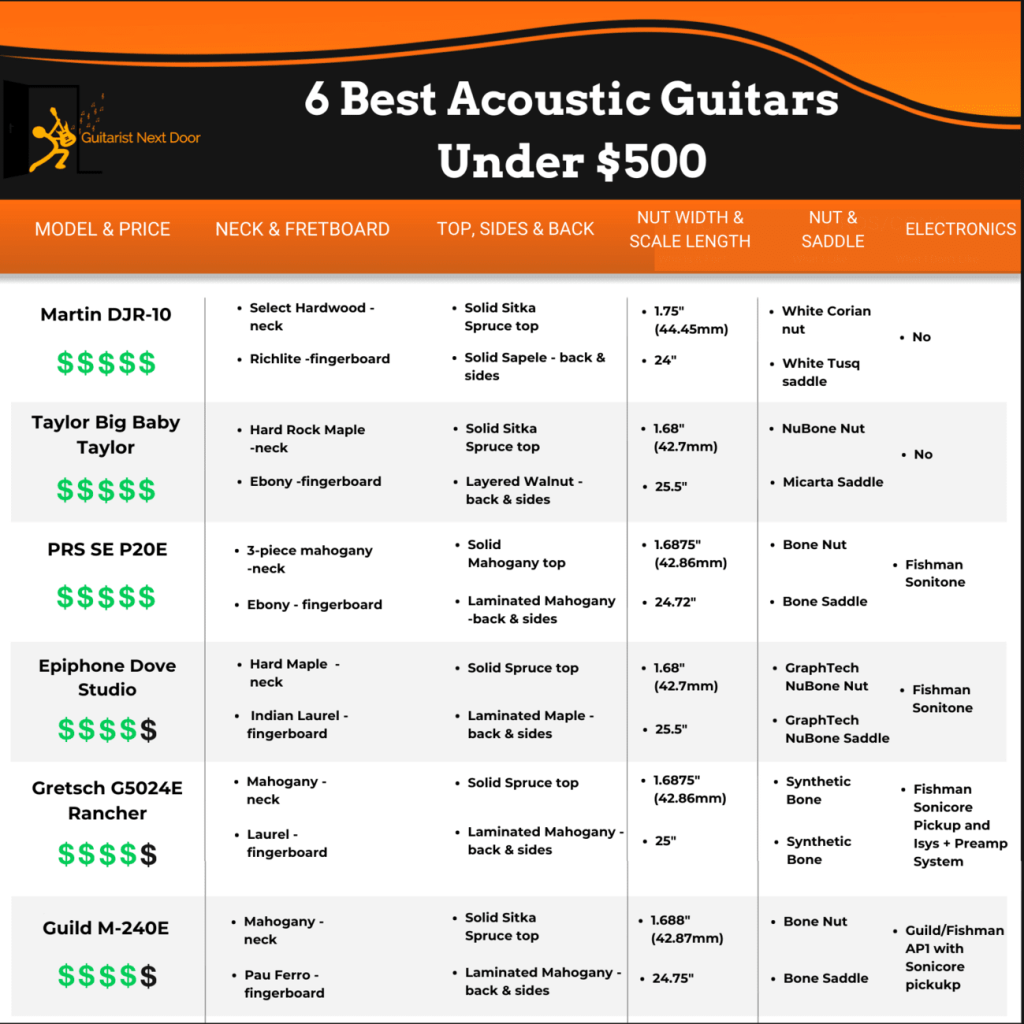
Compare The Tonewoods:
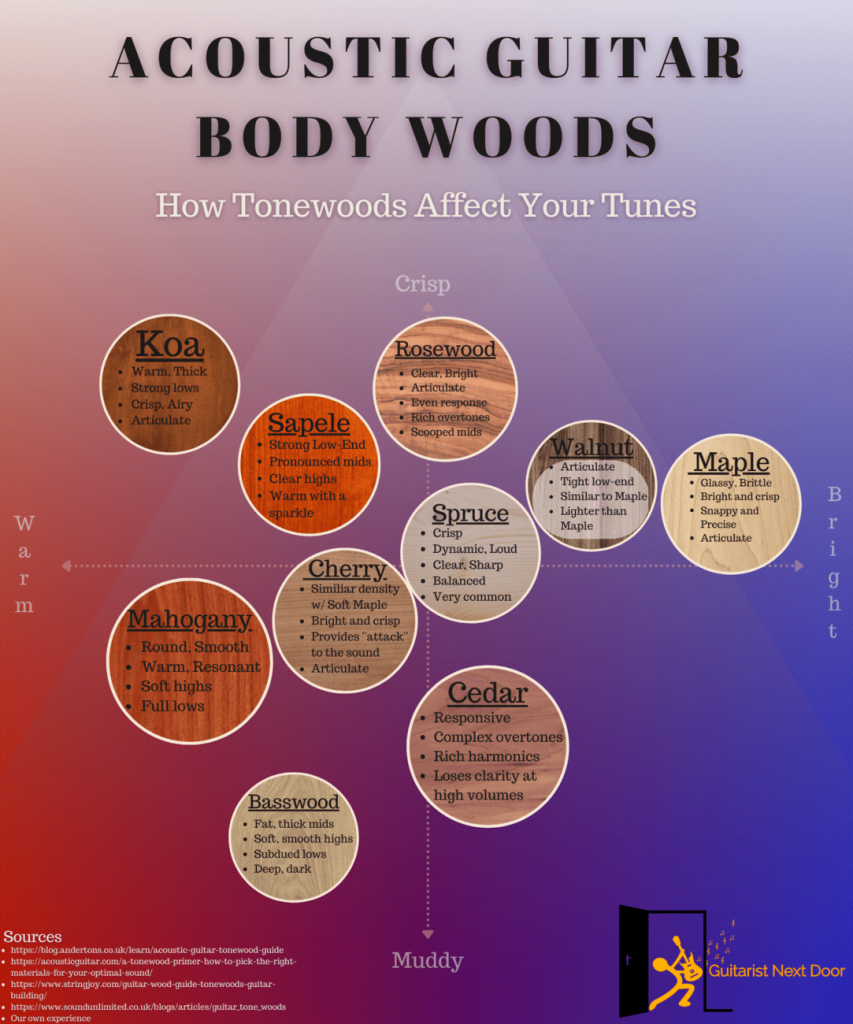
Body Top: Solid Sitka Spruce
Sides: Solid Sapele
Back: Solid Sapele
Neck: Select Hardwood
Fretboard: Richlite
Body Top: Solid Sitka Spruce
Sides: Layered Walnut
Back: Layered Walnut
Neck: Hard Rock Maple
Fretboard: Ebony
Body Top: Solid Mahogany
Sides: Laminated Mahogany
Back: Laminated Mahogany
Neck: Mahogany
Fretboard: Ebony
Body Top: Solid Spruce
Sides: Laminated Maple
Back: Laminated Maple
Neck: Hard Maple
Fretboard: Indian Laurel
Body Top: Solid Spruce
Sides: Laminated Mahogany
Back: Laminated Mahogany
Neck: Mahogany
Fretboard: Laurel
Body Top: Solid Sitka Spruce
Sides: Laminated Mahogany
Back: Laminated Mahogany
Neck: Mahogany
Fretboard: Pau Ferro
You can learn more about tonewoods here and more about acoustic guitar history here!
When I sat down to write this guide, I realized something very important: this is, perhaps, the most competitive price range for this instrument in the market.
This explains why, when you tried to look for the “best acoustic-electric guitar under 500” on Google, you were mesmerized by the number of results. Yes, what you need is a guide to help you choose from such a wide variety of options.
That’s what we’re here for, so worry not.
Read on, you will find some truly excellent affordable guitars here and most likely fall in love with your new six-stringer.
GNDs reviews of the top 6
Know what you can afford and then buy the best guitar you can afford.
I learned this rule of thumb from The Guitar Handbook written by Ralph Denyer.
What kind of sound are you after?
- Warm and full?
- Bright and clear?
- Soft and balanced?
Know what you are after and you are on your way to choosing the right guitar for you!
Learn more about acoustic guitar tonewoods here.
Choose a guitar that enables you to play the music you love.
Best Overall – Martin DJR-10
Specs
| Body Style | Junior Dreadnaught (featuring 000-shape depth) |
| Top | Solid Sitka Spruce |
| Back & Sides | Solid Sapele |
| Neck | Select Hardwood |
| Neck Shape | Dreadnought Junior |
| Fretboard | 20 frets, Richlite fingerboard, 16″ radius. |
| Nut material | White Corian |
| Nut Width | 1.75″ |
| Electronics | No |
| Saddle | White Tusq |
| Scale-Length | 24″ |
The first thing to say about this Martin JR is that it ticks all the important boxes to be a great acoustic guitar. Yes, don’t let the size fool you since this is very close to a full-on Martin (15/16 of it) and can produce the original & classic Martin tones we all know and love.
Yes, the advanced X and scalloped bracing under the solid Sitka top enhances the low end and gives this smaller Martin guitar a much bigger sound. Speaking of sound quality, the combination of Sitka spruce for the top and solid Sapele for the back and sides (yes, you read that right, it’s an all-solid guitar in this price range) make it vibrate as a uniform piece and create the sounds you would expect from a much bigger (and expensive) guitar. This axe just sounds amazing for its price.
Also, speaking about sounds, this is an electric-acoustic guitar that features a Fishman Sonicore mic and preamp. Conveniently, and not to harm the natural vibration of the guitar’s solid wood, the preamp only occupies a minor space under the rosette with a volume and a tone knob. The only other part of the guitar that carries anything related to the Fishman Sonicore is the input jack that’s on the lower back of the guitar.
Sound-wise, the electronics on this Martin are, perhaps, its only lower point because they tend to take away all the low-end the company worked so hard to achieve in guitars this size.
Speaking of size, the common thing to happen when you pick up a smaller-scale guitar (Martin’s scale is 24”) is that your fingers feel cramped inside the first frets. This is a sensation associated mostly with Baby Taylors and Little Martins. Yet, that’s not the case here since the solid-wood neck with richlite fretboard feels and plays just like a normal guitar.
Furthermore, if you’re used to playing Mustangs or Jaguars, you’ll feel at home here. This Martin does offer great playground for all sorts of different playing techniques.
Finally, this guitar comes with a dedicated gig bag and is ready to create history in the right hands. Give it a try before you buy because this Martin is our pick as the best acoustic guitar for $500.
Pros:
- Martin tone at a fraction of Martin’s regular prices
- Solid-wood guitar (top, backs and sides, and neck) at a very affordable price
- Top-notch scalloped bracing for enhanced low-end
- Lightweight and travel-friendly
- Dedicated gig bag included
Cons:
- Fishman Sonicore lacks low end.
- Richlite fingerboard and bridge might seem a little too plastic for some purists.
Our Ratings:
| Feature | Rating from 1-5 |
| Sound | 4.5 |
| Playability | 4.5 |
| Overall Quality | 4.5 |
| Value For Money | 5 |
| Fingerpicking feel | 4 |
Who is this guitar for?
This axe is perfect for the amateur player trying to take a leap in build quality and sound, beginners, and children in need of a learner-size guitar. Also, these make terrific road-ready guitars to leave your precious full-size Martin safe at home without sacrificing tone. It’s “just” a traditional acoustic, but it offers all solid woods, smooth playability, and Martin tones.
Who is this guitar NOT for?
This guitar is not for those looking to get their kids a smaller, toy-like guitars because it is a serious instrument ready to deliver amazing tones.
Runner-Up – Taylor Big Baby Taylor
Specs
| Body Shape | Full-Sized Dreadnought |
| Top | Solid Sitka Spruce |
| Back & Sides | Layered Walnut |
| Neck | Hard Rock Maple |
| Neck Shape | not available |
| Fretboard | 20 frets, Ebony fingerboard |
| Nut | NuBone |
| Nut Width | 1.68″ |
| Electronics | No |
| Saddle | Micarta |
| Scale-Length | 25.5″ |
The Big Baby Taylor is the most affordable full-scale guitar made by Taylor guitars. Yes, the size of the body is 15/16 of a full-size dreadnaught but it features a 25 ½” scale just like regular guitars do. Therefore, although it is travel-friendly and a little smaller body-wise, it feels and plays like the real thing.
Speaking of which, Taylor guitars has treated the guitar’s body to make it wider in the middle using an arched-back technique that gives it a slightly higher output, especially at the low end of the spectrum. As a result, although you’re holding a slightly smaller and more maneuverable dreadnought guitar, the sound and feel are of a regular-sized guitar.
This brings us to speak about the super friendly neck that feels and plays like a Taylor neck should. Moreover, the ebony fretboard is quite an unusual encounter in this price range. The answer to that question in your mind is that the neck is made of maple. Yes, that’s where the money comes from. Furthermore, the sides and back are made of three-piece laminated walnut while the top is solid Sitka spruce.
This is the only reason why this axe comes second after the Martin DJR. Other than the tonewood, the sound, feel, and craftsmanship of this guitar are what you would expect of a Taylor with one extra digit on the price tag.
Finally, the Taylor sound that became the trademark of countless hits is right there at your fingertips at all times with the Big Baby.
Oh, and an extra mention for the quality of the guitar’s gig bag. I own a Baby Taylor that’s traveled with me inside that bag for over 15 countries. They’re built to last. What a beautiful guitar!
Pros:
- 25 ½” scale on a 15/16 body
- Ebony fingerboard
- Solid Sitka spruce top
- Durable, rugged gig bag
- Offers the Taylor sound
- Great playability, friendly neck
- Real Taylor at an affordable price
Cons:
- Laminated back and sides
- No electronics
- Maple neck
Our Ratings:
| Feature | Rating from 1-5 |
|---|---|
| Sound | 4.3 |
| Playability | 4.6 |
| Overall Quality | 4.5 |
| Value For Money | 5 |
| Fingerpicking feel | 4 |
Who is this guitar for?
The wood combination of neck, body, fretboard, and top makes this a killer lead instrument. Yes, that mix between the snappy highs of the maple and the ebony together with the high end of the Sitka spruce, and anchored by walnut’s midrange can cut any mix.
Who is this guitar NOT for?
The Taylor Big Baby is not for those in search of the classic middle-of-the-mix sound with growling low end and sparking highs. These are different, more modern-sounding guitars with a ferocious midrange and musical harmonic overtones.
Check Price on:
Best for Fingerpicking – PRS SE P20E
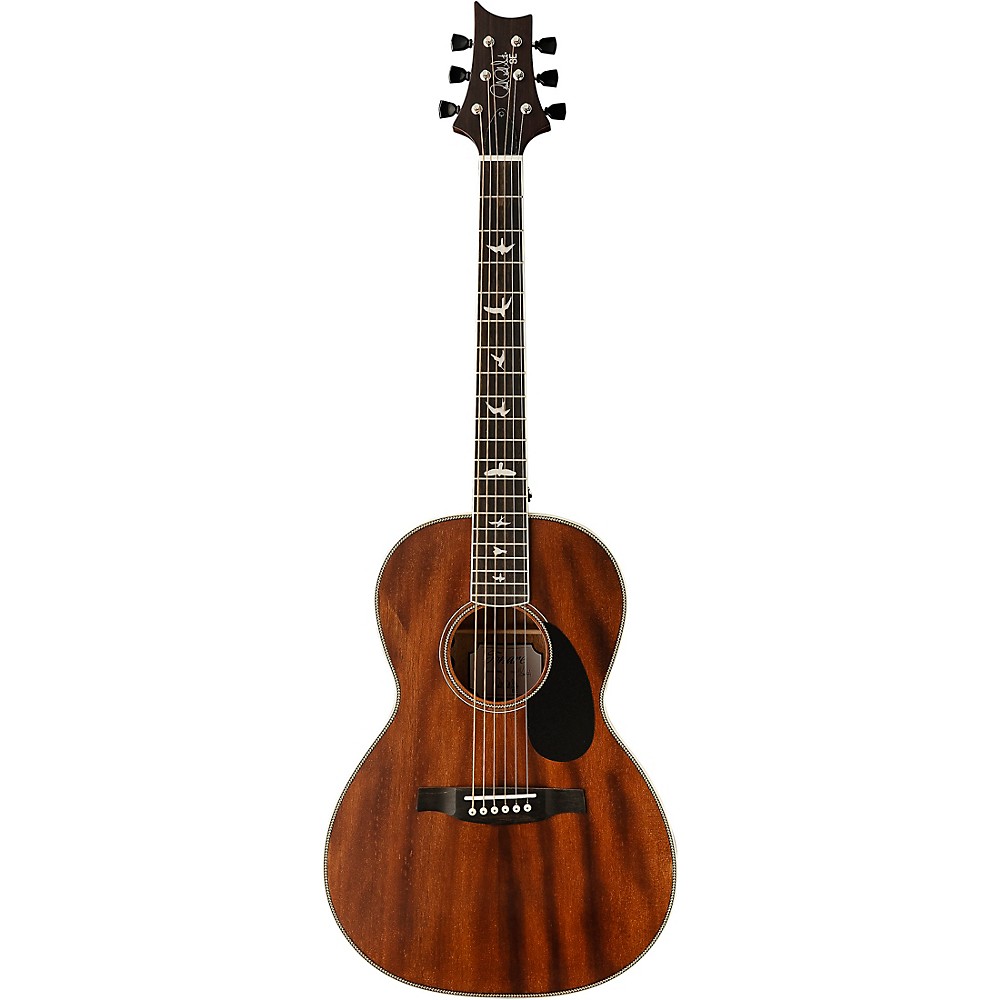
Specs
| Body Shape | Parlor |
| Top | Solid Mahogany |
| Back & Sides | Laminated Mahogany |
| Neck | 3-piece mahogany |
| Neck Shape | Wide Fat |
| Fretboard | 20 frets, Ebony fingerboard, 11.8″ radius |
| Nut | Bone |
| Nut Width | 1.6875″ |
| Electronics | Fishman Sonitone |
| Saddle | Bone |
| Scale-Length | 24.72″ |
Parlor guitars make terrific fingerpicking instruments. Out of all the parlor guitars out there we chose this PRS SE model because it is the cleverest setup for a parlor guitar currently in the market.
How so? You might be wondering, well, simply the guitar’s size and wood combination make it a crossover that can bring the best of both worlds to your music.
Yes, on one hand, the body is made of mahogany (laminated for the sides and back) and features a mahogany top as well. Mahogany is a tonewood that is famous for being the low-end anchor of many acoustics. Mahogany also provides a mellow and warm tone.
So, the mahogany body is mixed with a mahogany neck with rosewood fingerboard and the entire guitar becomes this perfect mix of the high end that’s natural to parlor-sized guitars with a deep and resonant low end you would expect from a much larger instrument.
Furthermore, the hybrid bracing that PRS employs allows the low end to appear through the soundhole and make it to your audience’s ears. Yes, we’re talking of a mix of modern X-style bracing with traditional bracing to make the most of that mahogany top.
As a result, this PRS SE matches its impeccable construction with to-die-for tones right at your fingertips.
But that’s not all since this guitar is also a beautiful instrument that represents that typical PRS look from head to toe. Yes, the 3-piece neck with its rosewood fingerboard offers the traditional white binding, bird inlays, and the PRS headstock.
Speaking of the neck, it features PRS’ wide fat shape which gives the axe enough meat to grab onto without being bulky or feeling uncomfortable.
Finally, this amazing combo is finished with a Fishman Sonicore and a state-of-the-art PRS gig bag that’s built to protect your guitars for decades.
Getting this tone and features in a guitar under $500 is big news, so go grab one while you can!
Pros:
- Solid mahogany top for added low end
- Hybrid bracing to enhance the tones from the solid top
- Included gig bag
- Mahogany neck with traditional bird inlays and binding
- Fishman Sonitone installed
- Wide Fat neck profile for enhanced comfort and playability
Cons:
- Laminated back and sides
- 3-piece neck
- Fishman Sonitone is not the best for picking up the low end
Our Ratings:
| Feature | Rating from 1-5 |
|---|---|
| Sound | 3.9 |
| Playability | 4.5 |
| Overall Quality | 4.5 |
| Value For Money | 4.5 |
| Fingerpicking feel | 4.7 |
Find more great Parlor guitars here.
Who is this guitar for?
This is the perfect guitar for those who love fingerpicking and need the snappy high end of the guitar to cut through the mix. Also for those who like smaller-body and want the quintessential PRS look and tone at a fraction of the price.
Who is this guitar NOT for?
Buying a child guitars of this caliber could be a recipe for disaster since it is a full-size instrument capable of some serious tones and it might be damaged due to the careless handling of a kiddo. Also, those looking for a smaller guitar for their smaller hands will find the wide fat neck to be a little too big.
Check Price on:
Best for Strumming – Epiphone Dove Studio
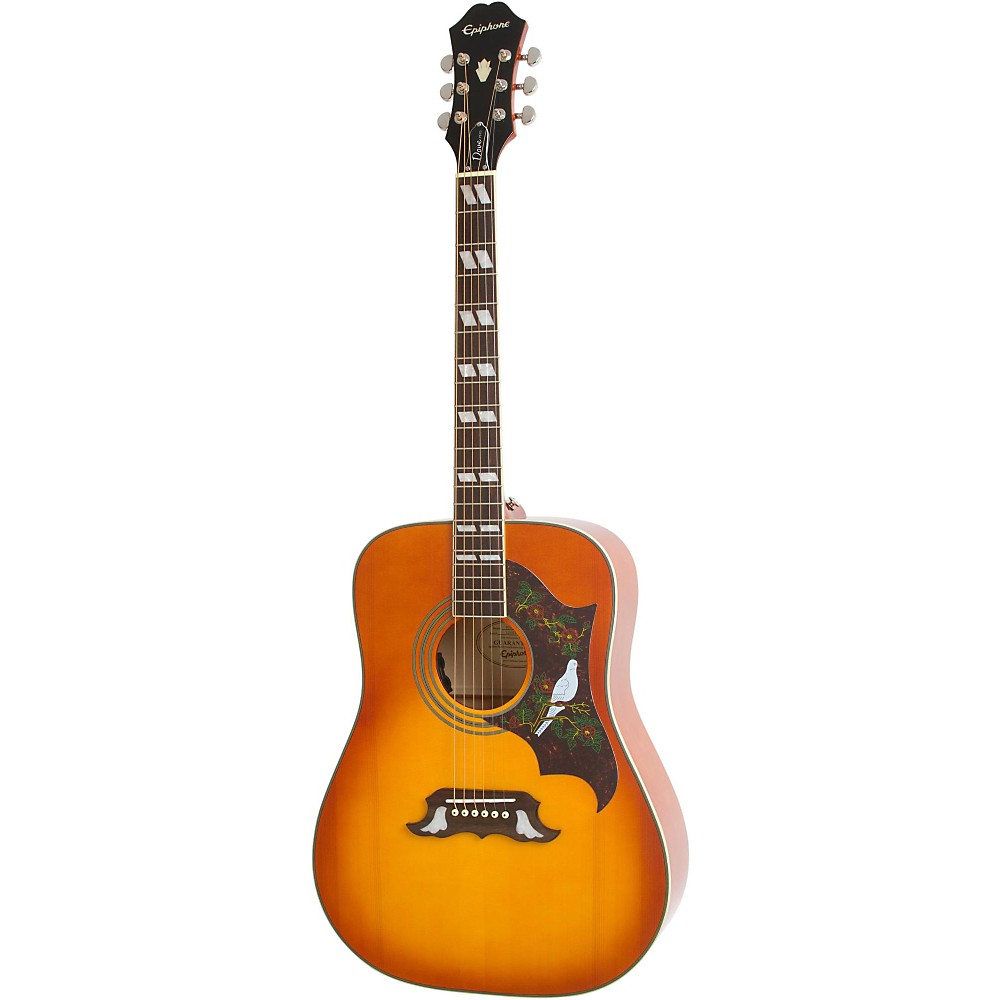
Specs
| Body Shape | Square Shoulder Dreadnought |
| Top | Solid Spruce |
| Back & Sides | Laminated Maple |
| Neck | Hard Maple |
| Neck Shape | SlimTaper D |
| Fretboard | 20 Medium Jumbo frets, Indian Laurel fingerboard, 12″ radius |
| Nut | GraphTech NuBone |
| Nut Width | 1.68″ |
| Electronics | Fishman SoniTone |
| Saddle | GraphTech NuBone |
| Scale-Length | 25.5″ |
When we think of the best acoustic-electric guitar, the shape and colors of this model surely come to mind. Yes, this is a replica of the amazing Gibson Dove that we saw on countless stages and heard on countless records.
Why is this guitar in the category of “best for strumming”? Well, the answer is that no other guitar in this list can provide the player with those round, musical, and beautiful harmonic overtones, and that snappy high-end this guitar oozes.
Moreover, when you strum any chord on this guitar, the first thing you notice is the balance between the low end and the high end is close to perfect. Yes, I know, if you try a Gibson original you get rid of the excess of high-end that these have, but being a budget acoustic when compared to the Gibson, you get still high definition across the board.
This is not a coincidence by any means; on the contrary, it is the outcome of a decades-old recipe. Yes, the back and sides of this guitar are made of laminated maple and it features a solid Sitka spruce top. The neck is made of hard maple and the fretboard, as well as the bridge, is made of Indian laurel.
If you add up the enormous amount of maple and the Sitka spruce top what you get is resonance and lots of high-end. Then, coupling that with the depth of the beautifully-ornamented dreadnought body what you have is record-ready tones, especially when strumming chords.
Finally, the Fishman Sonitone system adds a welcome feature for those of us who still believe in acoustic shows. So, although it is not a guitar that oozes solid-wood construction, it is, in my opinion, the best strumming acoustic-electric guitar under 500.
Moreover, plug it into an acoustic guitar amp, and you’ll realize in a nanosecond that these guitars were made for the stage.
Pros:
- Historic Dove pickguard and perfect finish
- Packs countless classic tones
- The hard maple neck makes it more resistant and road-ready
- Fishman Sonitone preamp system as a factory feature
- Violin burst finish
- Glossy finish
Cons:
- Laminated back and sides
- No gig bag included
Our Ratings:
| Feature | Rating from 1-5 |
|---|---|
| Sound | 4.3 |
| Playability | 4.3 |
| Overall Quality | 4.8 |
| Value For Money | 5 |
| Fingerpicking feel | 3.9 |
Who is this guitar for?
This is for the owner of an original who wants to preserve that guitar and hit the road with a budget-level guitar. Also for the amateur musician and the bonfire lover who needs a great guitar that won’t break the bank but deliver classic acoustic tones for timeless masterpieces. Works well for singer songwriters too.
Who is this guitar NOT for?
This is not for children or beginners who want their first guitar. Also, it is not for those looking for Martin-like massive low-end sounds.
Check Price on:
Best For Blues – Gretsch G5024E Rancher
Specs
| Body Shape | Dreadnought |
| Top | Solid Spruce |
| Back & Sides | Laminated Mahogany |
| Neck | Mahogany |
| Neck Shape | not available |
| Fretboard | 21 Vintage-Style frets, Laurel fingerboard, 12″ radius. |
| Nut | Synthetic Bone |
| Nut Width | 1.6875″ |
| Electronics | Fishman Sonicore Piezo Pickup and Isys + Preamp System |
| Saddle | Compensated Synthetic Bone |
| Scale-Length | 25″ |
A big guitar with a big voice, the Gretsch G5024E Rancher Dreadnought is built for volume. Like its name, the tone of the Rancher calls to mind rough and rowdy Western music—a strong, proud arch back acoustic that’s ready and looking for a fight.
You’ll find nothing lacking in any range as you strum through booming progressions and pick out pronounced, powerful riffs.
And if you ever need extra juice, the Fishman Isys III System and Sonicore piezo pickup duo are at your command. This electronic setup gives you responsive, organic amplification you can mold to your liking with 3-band EQ.
These high quality tones are right at your fingertips, easily played on the slightly narrow neck.
The Rancher sports a smooth, rosewood fingerboard and is lined with vintage-size frets for an organic playing feel that puts you in contact with the fretboard wood.
This choice of fret size, combined with the G5024E’s heavy gauge strings, might make bends a bit difficult.
But the flipside is that the upper reaches of the fretboard are a little more spacious than average, so high-end licks are a bit easier to nail.
Constructed with a solid spruce top and mahogany back and sides, the Rancher is right in line with the highest quality acoustics you can find under $500. Its compensated saddle and deluxe die-cast tuning machines hold your strings pitch-perfect through hours of pitch-perfect playing.
Find more guitars with offset soundhole here.
Pros
- The unusual triangle-shaped soundhole is unique and eye-catching
- A powerful, rich voice from an arch back design
- Arched-back design boosts volume
- Great acoustic tone with a decent electronic system
- Vintage-style frets let your fingers feel the fretboard
- You really feel the instrument when playing
- Comfortable and slim neck
- Versatile, delivers from delta blues to blues rock
Cons
- Non-cutaway acoustic-electric limits high fret access
- Synthetic bone nut and saddle
Our Ratings:
| Feature | Rating from 1-5 |
|---|---|
| Sound | 4.1 |
| Playability | 4.5 |
| Overall Quality | 4.5 |
| Value For Money | 5 |
| Fingerpicking feel | 4 |
Find more great acoustics for blues here.
Who is this guitar for?
If you are in search of a solid top guitar that handles blues exceptionally well and is comfortable to play the Gretsch G5024E Rancher is easily one of the best options for under $500.
Who is this guitar NOT for?
If you are after a cutaway, bone nut & saddle, and all-solid woods, this Rancher is not for you.
Check Price on:
Best for Beginners – Guild M-240E
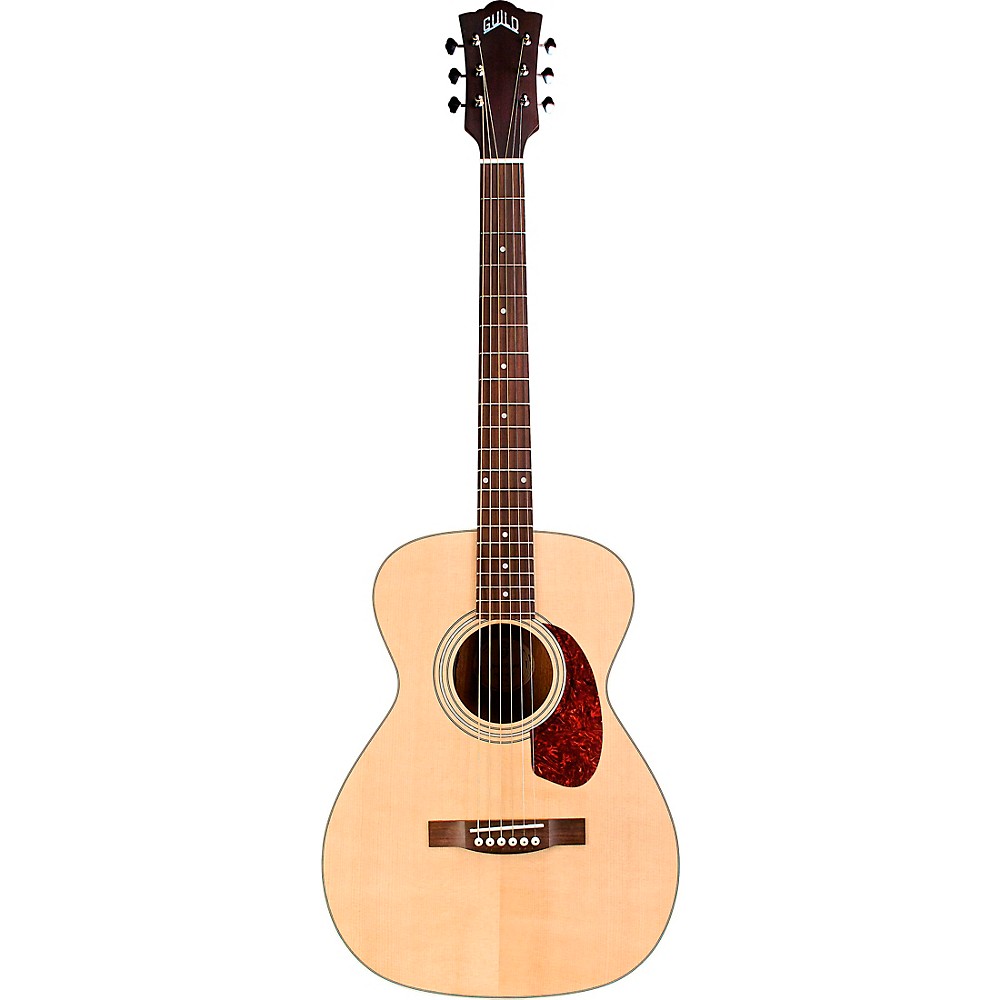
Specs
| Body Shape | Concert |
| Top | Solid Sitka Spruce |
| Back & Sides | Laminated Mahogany |
| Neck | Mahogany |
| Neck Shape | Slim C |
| Fretboard | 20 frets, Pau Ferro fingerboard, 16″ radius |
| Nut | Bone |
| Nut Width | 1.688″ |
| Electronics | Guild/Fishman AP1 with Sonicore pickukp |
| Saddle | Bone |
| Scale-Length | 24.75″ |
While the Martin DJR is the solid-wood, higher-end version of traditional acoustic guitars, this Guild can provide similar tones and looks without being such a fragile all-solid instrument. Furthermore, this combination of traditional tones and looks with an affordable price tag and the durability of laminated wood make this Guild M-240E the perfect choice for beginners and amateurs on a budget.
Yes, Guild is another legendary guitar builder that has had a vast influence on Western music for decades. In this case, they poured all that leverage into their most famous guitar shape to offer classic tones and a timeless look at a price most players can afford.
To begin with, the combination of (laminated) mahogany for the back and sides with a solid Sitka spruce top makes this a classic-sounding instrument.
Yes, the tested-and-true formula of mixing the low end of the mahogany and the brightness of the spruce works perfectly here.
Speaking of tonewoods, the neck is made of mahogany but the fingerboard is made of Pau Ferro (as well as the bridge), a tonewood that has become the go-to option to replace rosewood giving to this guitar similar sweet notes in the resulting audio the rosewood would.
Also, this Guild is made following the M-Concert line making the guitar’s body slightly smaller and more maneuverable than a full-body dreadnought or jumbo. This is not a pointless detail since it makes the guitar’s playability grow immensely.
In addition, the electronics of this guitar are your trusty Fishman Sonitone preamp system but made in collaboration with Guild so it could be fine-tuned to match this guitar particularly. As a result, this guitar produces balanced sound & classic tones when playing it unplugged and also when run through an amp.
Finally, the C-Shape neck, low action, 24 ¾” scale, and 20 frets make this a good guitar for the electric guitar player who is making the transition, a smaller-hands player, or a beginner trying to fight against the instrument less while learning.
A final paragraph should be awarded for the super-padded, utterly comfortable, and ultra-high-quality gig bag that can keep your guitars safe even in the most demanding circumstances. All these things combined make this Guild easily one of the greatest budget acoustics.
Pros:
- Solid Sitka spruce top
- Padded gig bag
- Factory-included Fishman Sonitone electronics
- Comfortable C-Shaped neck
- Prototypical wood combinations and tones
- Scalloped X internal bracing for added tone and sustain
Cons:
- Laminated back and sides
- Pau Ferro fingerboard and bridge instead of rosewood or ebony
Our Ratings:
| Feature | Rating from 1-5 |
|---|---|
| Sound | 4.1 |
| Playability | 4.5 |
| Overall Quality | 4.5 |
| Value For Money | 4.7 |
| Fingerpicking feel | 4.1 |
Who is this guitar for?
This is the perfect guitar to play countless gigs on; so, if you’re an artist looking for a workhorse, here’s your guitar. Also, beginners who want a mid-range instrument to focus their fight against their hands and brains instead of a faulty guitar will find this Guild a great choice.
Who is this guitar NOT for?
Seasoned players looking for the legendary Guild tone on a budget will not find it here since these guitars are intermediate-oriented.
Check Price on:
For a bit more expensive but still affordable axes, check our favorite acoustics under $1000.
Runner-Ups That Just Missed The Top 5
-
Best Fender Acoustic for Under $500 – Fender Malibu Player
-
Best for Fingerpicking Runner-up – Epiphone EL-00
-
Best With A Cutaway for Under $500 – Epiphone Hummingbird Studio
-
Best Beginner-Oriented for Under $500 – Fender CD-60 All Mahogany
-
Best Ibanez Acoustic for Under $500 – Ibanez AEG550 Bocote
-
Best for Recording Under $500 –Washburn Heritage F11S
-
Best 12-String for Under $500 –D’Angelico Premier Fulton LS 12-string
-
Best Jumbo Acoustic for Under $500 –Epiphone J-200EC Studio
-
Best Travel Acoustic for Under $500 –Martin LX1E Little Martin
How We Chose These Acoustic Guitars
- We decided which acoustic guitars to recommend by using our own experience, doing extensive research, visiting music stores, and asking help from our musician friends
- After we had chosen the guitars to recommend we looked for a good way to test the gear. This means either renting it, buying it, testing it in a music store, or visiting a friend who owns it. This time, our main testing methods were playing these guitars at music stores and relying on our past experience playing these guitars.
- Even after this, we’ll still do another round of extensive research to make sure that this specific product is in fact, a real cream-of-the-crop candidate.
- Then we wrote this in-depth but easily digestible review about these axes. We kept in mind who will be playing them (most likely) such as beginner players, fingerstyle players, players who love blues, budget players, etc.
Most acoustic guitars we recommend are run through tests like these:
- We go carefully through the finish and build quality of the guitar.
- We inspect the fretwork and edges of the fretboard to make sure there are no sharp edges.
- We play the guitar unplugged and plugged in.
- We use different playing techniques, such as fingerpicking, flatpicking, strumming, tapping, and even percussive playing.
- We measure and weight the guitar.
- We try licks and riffs from different genres.
Learn more about GND’s testing and reviewing processes here.

which acoustic guitar costing under $500 you would recommend for soloing?
Hi Keith! I would check Ibanez AEWC32FM out! It’s a great acoustic guitar costing under $500 for acoustic soloing.